But your work is not over.
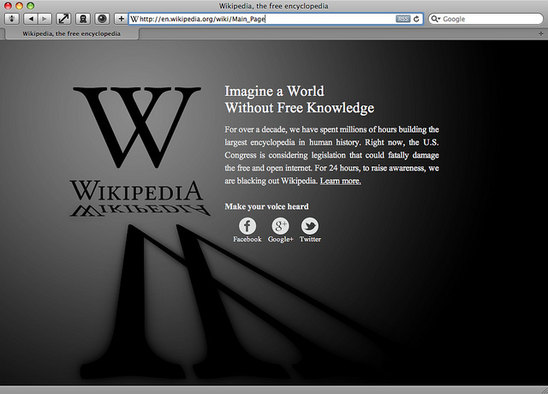
On January 18 the users and companies of the internet rallied together to protest against SOPA and PIPA, bills that would censor the internet. Check out the numbers. It worked. Here‘s part of a huge list, with even bigger names on it of the sites that participated in the blackout. Google, Wikipedia, Reddit, BoingBoing and Wired are among them. Here’s the page Wikipedia displayed. The Wikipedia page about SOPA and PIPA was accessed more than 162 million times during the 24 hours the site was blacked out. More than eight million people looked up their elected representatives’ contact information via Wikipedia’s tool, crashing the Senate’s website. At one point, 1% of all tweets on Twitter included the #wikipediablackout hashtag.
SOPA? PIPA?
- Wikipedia explains, and has some links here.
- One page PDF guide to the bills from EFF
Is it over?
It is likely the bills will be back in one form or another:
What’s the best way for me to help? (for U.S. citizens)
The most effective action you can take is to call your representatives [phone calls have the most impact] in both houses of Congress, and tell them you oppose SOPA, PIPA, and the thinking behind them.[9]
What’s the best way for me to help? (for non-U.S. citizens)
Contact your country’s Ministry of Foreign Affairs or similar government agency. Tell them you oppose SOPA and PIPA, and any similar legislation. SOPA and PIPA will affect websites outside of the United States, and even sites inside the United States (like Wikipedia) that also affect non-American readers — like you. Calling your own government will also let them know you don’t want them to create their own bad anti-Internet legislation.
For New Zealanders, that’s the Ministry of Foreign Affairs and Trade. Their contact details are here.
Megaupload
Megaupload’s website was taken down a day after the protest (without trial), with related people being arrested in New Zealand, and property confiscated. Are we okay with helping enforce US copyright law which, as SOPA and PIPA shows is heavily influenced by the entertainment industry? Is this what extradition should be used for?
It appears, at first glance, that Megaupload was removing infringing material on request. Although it seems their take down procedure was molded around the way they store files–only storing one copy of it if it is uploaded more than once, but giving out a unique URL for the file.
Megaupload has many similarities to other websites, which makes this concerning. It was definitely used for legitimate and legal purposes by legitimate users.
Tech Liberty asks do we need to obey laws from other countries while on the internet, if so, what countries?
Even if I have a web host in one country, what if they provide services via another country? The internet is so connected, how do we know whose laws apply?
Image credit: LoveNMoreLove/Wikipedia
 Macsyna King cooperated with the police and was a prosecution witness, she hasn’t just decided to speak now. She isn’t profiting from the book either, Ian says: “Apart from sharing a Domino’s pizza during lunch, Macsyna has never received anything nor will she.” Ian will earn money for the book, but points out that researching and publishing a book takes time and money and that
  Singer Tiki Taane was arrested earlier this month after singing lyrics from the rap group N.W.A after the police entered a venue he was performing at. The police left and apparently there was no intention to arrest him on return, but he “refused to co-operate” and “he was completely out of control”. The promoter and the DJ were also arrested, I’m not sure what for, however they seem to have been released without charge. Taane was charged with disorderly behavior likely to cause violence.